


Page 139 - Math Course 2 (Book 2)
P. 139
Triangle Inequality Theorem


               Determine Possible Side Lengths                    Prove Theorem 10.11

                   Example                                           Example


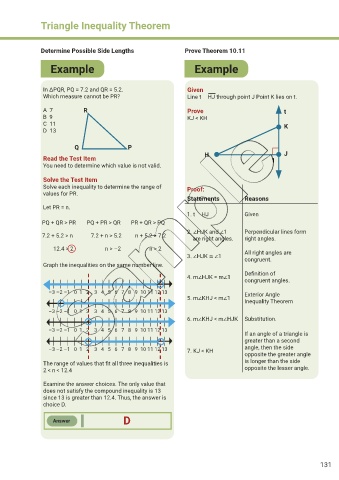
                In ΔPQR, PQ = 7.2 and QR = 5.2.                    Given
                Which measure cannot be PR?                        Line t ⟂ HJ through point J Point K lies on t.

                A  7          R                                    Prove                             t
                B  9                                               KJ < KH
                C  11                                                                                K
                D  13

                           Q                  P
                                                                         H                           J
                Read the Test Item                                                              1
                You need to determine which value is not valid.

                Solve the Test Item
                Solve each inequality to determine the range of    Proof:
                values for PR.
                                                                   Statements          Reasons
                Let PR = n.
                                                                   1. t ⟂ HJ           Given
                PQ + QR > PR   PQ + PR > QR    PR + QR > PQ
                                                                   2. ∠HJK and ∠1      Perpendicular lines form
                7.2 + 5.2 > n     7.2 + n > 5.2     n + 5.2 > 7.2      are right angles.  right angles.

                        12.4 > 2               n > –2               n > 2              All right angles are
                                                                   3. ∠HJK ≅ ∠1        congruent.
                Graph the inequalities on the same number line.
                                                                                       Definition of
                                                                   4. m∠HJK = m∠1
                                                                                       congruent angles.
                   –3 –2 –1   0  1   2    3   4   5   6   7   8   9  10 11 12 13       Exterior Angle
                                                                   5. m∠KHJ < m∠1
                                                                                       Inequality Theorem
                   –3 –2 –1   0  1   2    3   4   5   6   7   8   9  10 11 12 13
                                                                   6. m∠KHJ < m∠HJK    Substitution.

                   –3 –2 –1   0  1   2    3   4   5   6   7   8   9  10 11 12 13
                                                                                       If an angle of a triangle is
                                                                                       greater than a second
                   –3 –2 –1   0  1   2    3   4   5   6   7   8   9  10 11 12 13  7. KJ < KH  angle, then the side
                                                                                       opposite the greater angle
                The range of values that fit all three inequalities is                 is longer than the side
                2 < n < 12.4                                                           opposite the lesser angle.

                Examine the answer choices. The only value that
                does not satisfy the compound inequality is 13
                since 13 is greater than 12.4. Thus, the answer is
                choice D.
                                            D
                    Answer


                                                                                                                 131

