


Page 136 - Science Course 1 (Book 2)
P. 136
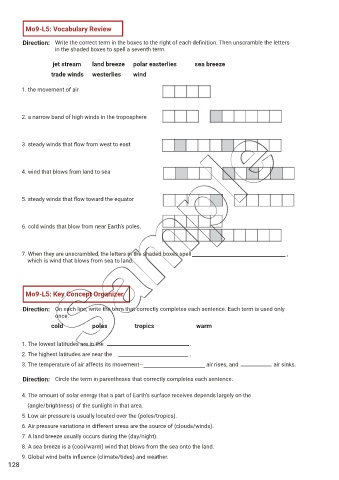
Mo9-L5: Vocabulary Review

         Direction: Write the correct term in the boxes to the right of each def nition. Then unscramble the letters
                    in the shaded boxes to spell a seventh term.

                    jet stream    land breeze   polar easterlies     sea breeze

                   trade winds   westerlies     wind

         1. the movement of air


         2. a narrow band of high winds in the troposphere


         3. steady winds that f ow from west to east


         4. wind that blows from land to sea


         5. steady winds that f ow toward the equator


         6. cold winds that blow from near Earth’s poles.


         7. When they are unscrambled, the letters in the shaded boxes spell                          ,
             which is wind that blows from sea to land.


          Mo9-L5: Key Concept Organizer

         Direction: On each line, write the term that correctly completes each sentence. Each term is used only
                    once.

                   cold          poles           tropics              warm


         1. The lowest latitudes are in the                           .
         2. The highest latitudes are near the                        .
         3. The temperature of air affects its movement—                  air rises, and            air sinks.

         Direction: Circle the term in parentheses that correctly completes each sentence.


         4. The amount of solar energy that a part of Earth’s surface receives depends largely on the
             (angle/brightness) of the sunlight in that area.
         5. Low air pressure is usually located over the (poles/tropics).

         6. Air pressure variations in different areas are the source of (clouds/winds).
         7. A land breeze usually occurs during the (day/night).
         8. A sea breeze is a (cool/warm) wind that blows from the sea onto the land.
         9. Global wind belts inf uence (climate/tides) and weather.
    128

