


Page 174 - Science Course 3 (Book 2)
P. 174
Mo12-L2b: Why Do the Seasons Change?


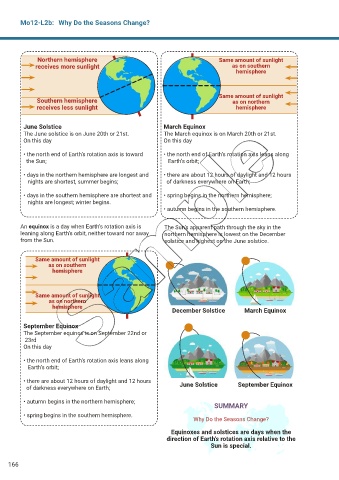
              Northern hemisphere                                             Same amount of sunlight
             receives more sunlight                                                as on southern
                                                                                    hemisphere


                                                                              Same amount of sunlight
              Southern hemisphere                                                  as on northern
              receives less sunlight                                                hemisphere


         June Solstice                                     March Equinox
         The June solstice is on June 20th or 21st.        The March equinox is on March 20th or 21st.
         On this day                                       On this day

         • the north end of Earth’s rotation axis is toward   • the north end of Earth’s rotation axis leans along
           the Sun;                                           Earth’s orbit;

         • days in the northern hemisphere are longest and   • there are about 12 hours of daylight and 12 hours
            nights are shortest, summer begins;              of darkness everywhere on Earth;

         • days in the southern hemisphere are shortest and   • spring begins in the northern hemisphere;
            nights are longest; winter begins.
                                                           • autumn begins in the southern hemisphere.


        An equinox is a day when Earth’s rotation axis is   The Sun’s apparent path through the sky in the
        leaning along Earth’s orbit, neither toward nor away   northern hemisphere is lowest on the December
        from the Sun.                                      solstice and highest on the June solstice.


             Same amount of sunlight
                  as on southern
                   hemisphere


             Same amount of sunlight
                  as on northern
                   hemisphere
                                                             December Solstice         March Equinox


         September Equinox
         The September equinox is on September 22nd or
          23rd
         On this day

         • the north end of Earth’s rotation axis leans along
            Earth’s orbit;

         • there are about 12 hours of daylight and 12 hours    June Solstice        September Equinox
           of darkness everywhere on Earth;

         • autumn begins in the northern hemisphere;
                                                                            SUMMARY
         • spring begins in the southern hemisphere.
                                                                     Why Do the Seasons Change?

                                                             Equinoxes and solstices are days when the
                                                            direction of Earth’s rotation axis relative to the
                                                                           Sun is special.


    166

