


Page 212 - Science Course 3 (Book 2)
P. 212
Mo13-L3a: How are the Outer Planets Similar?


        Jupiter

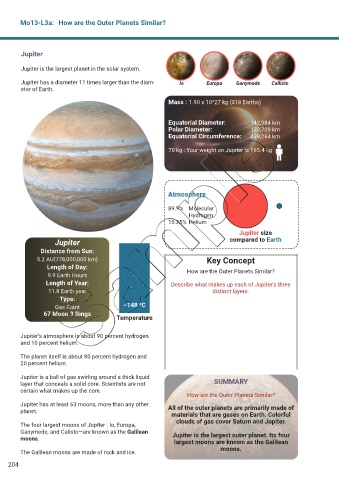
        Jupiter is the largest planet in the solar system.

        Jupiter has a diameter 11 times larger than the diam-                Io                  Europa           Ganymede         Callisto
        eter of Earth.

                                                            Mass : 1.90 x 10^27 kg (318 Earths)


                                                            Equatorial Diameter:         142,984 km
                                                            Polar Diameter:              133,709 km
                                                            Equatorial Circumference:    439,264 km

                                                            70 kg : Your weight on Jupiter is 165.4 kg


                                                            Atmosphere

                                                            89.9%  Molecular
                                                                   Hydrogen
                                                            10.25% Helium
                                                                                     Jupiter size
                    Jupiter                                                       compared to Earth
               Distance from Sun:
              5.2 AU(778,000,000 km)                                      Key Concept
                  Length of Day:                                   How are the Outer Planets Similar?
                  9.9 Earth Hours
                 Length of Year:                             Describe what makes up each of Jupiter’s three
                  11.8 Earth year                                           distinct layers.
                      Type:
                    Gas Giant               –148 0C
                67 Moon 3 Rings
                                          Temperature


        Jupiter’s atmosphere is about 90 percent hydrogen
        and 10 percent helium.

        The planet itself is about 80 percent hydrogen and
        20 percent helium.

        Jupiter is a ball of gas swirling around a thick liquid
        layer that conceals a solid core. Scientists are not                SUMMARY
        certain what makes up the core.
                                                                   How are the Outer Planets Similar?
        Jupiter has at least 63 moons, more than any other
        planet.                                             All of the outer planets are primarily made of
                                                             materials that are gases on Earth. Colorful
                                                               clouds of gas cover Saturn and Jupiter.
        The four largest moons of Jupiter - Io, Europa,
        Ganymede, and Calisto—are known as the Galilean
        moons.                                                Jupiter is the largest outer planet. Its four
                                                              largest moons are known as the Galilean
                                                                              moons.
        The Galilean moons are made of rock and ice.
    204

