


Page 71 - Math Course 3 (Book 1)
P. 71
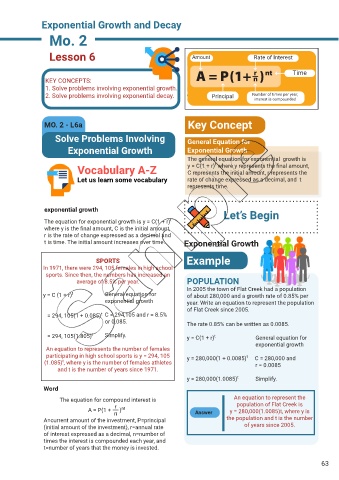
Exponential Growth and Decay

                  Mo. 2


                  Lesson 6                                           Amount               Rate of Interest


                                                                                                        Time
                 KEY CONCEPTS:
                 1. Solve problems involving exponential growth.
                 2. Solve problems involving exponential decay.            Principal      Number of times per year,
                                                                                          interest is compounded


                 MO. 2 - L6a                                       Key Concept

                    Solve Problems Involving                       General Equation for

                         Exponential Growth                        Exponential Growth
                                                                   The general equation for exponential  growth is
                                                                             t
                            Vocabulary A-Z                         y = C(1 + r)  where y represents the final amount,
                                                                   C represents the initial amount, r represents the
                            Let us learn some vocabulary           rate of change expressed as a decimal, and  t
                                                                   represents time.


                 exponential growth                                             Let’s Begin

                                                             t
                 The equation for exponential growth is y = C(1 + r)
                 where y is the final amount, C is the initial amount,
                 r is the rate of change expressed as a decimal and
                 t is time. The initial amount increases over time.  Exponential Growth


                                   SPORTS                          Example
                In 1971, there were 294, 105 females in high school
                 sports. Since then, the numbers has increased an
                            average of 8.5% per year.              POPULATION
                                                                   In 2005 the town of Flat Creek had a population
                y = C (1 + r) t       General equation for         of about 280,000 and a growth rate of 0.85% per
                                      exponential growth           year. Write an equation to represent the population
                                                                   of Flat Creek since 2005.
                   = 294, 105(1 + 0.085) C = 294,105 and r = 8.5%
                                     t
                                      or 0.085.                    The rate 0.85% can be written as 0.0085.

                   = 294, 105(1.805) t  Simplify.                  y = C(1 + r)   t          General equation for
                                                                                             exponential growth
                 An equation to represents the number of females
                 participating in high school sports is y = 294, 105  y = 280,000(1 + 0.0085)      C = 280,000 and
                                                                                        t
                       t
                 (1.085) , where y is the number of females athletes                         r = 0.0085
                     and t is the number of years since 1971.
                                                                                    t
                                                                   y = 280,000(1.0085)          Simplify.
                Word

                      The equation for compound interest is                        An equation to represent the
                                         r                                          population of Flat Creek is
                                A = P(1 +      ) nt                               y = 280,000(1.0085)t, where y is
                                         n                            Answer
                A=current amount of the investment, P=principal                  the population and t is the number
                (initial amount of the investment), r=annual rate                      of years since 2005.
                of interest expressed as a decimal, n=number of
                times the interest is compounded each year, and
                t=number of years that the money is invested.

                                                                                                                  63

