


Page 154 - Science Course 1 (Book 1)
P. 154
Mo5-L1a: What are the States of Matter?


                         Solids, Liquids, and Gases                             Key Concept

                Solid                                                       What are the States of Matter?
                Solids, such as rocks, do not change shape or         How do particles move in solids, liquids, and
                volume regardless of whether they are inside or
                outside a container.                                                   gases?
                Liquid
                A liquid, such as fruit juice, changes shape if it is
                moved from one container to another. Its volume
                does not change.
                Gas
                A gas, such as nitrogen dioxide, changes both
                shape and volume if it is removed from one con-
                tainer to another. If the container is not closed, the
                gas spreads out the container.


               All matter is made of tiny particles that are
               constantly moving.

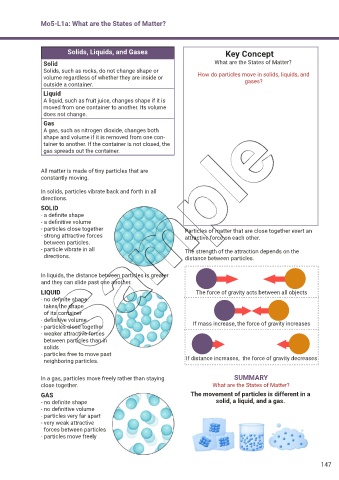
               In solids, particles vibrate back and forth in all
               directions.
               SOLID
               - a definite shape
               - a definitive volume
               - particles close together                         Particles of matter that are close together exert an
               - strong attractive forces                         attractive force on each other.
                 between particles.
               - particle vibrate in all                          The strength of the attraction depends on the
                 directions.                                      distance between particles.


               In liquids, the distance between particles is greater
               and they can slide past one another.
               LIQUID                                                 The force of gravity acts between all objects
               - no definite shape:
                 takes the shape
                 of its container
               - definitive volume
               - particles close together                            If mass increase, the force of gravity increases
               - weaker attractive forces
                 between particles than in
                 solids
               - particles free to move past
                 neighboring particles.                           If distance increases,  the force of gravity decreases


               In a gas, particles move freely rather than staying                 SUMMARY
               close together.                                              What are the States of Matter?
               GAS                                                  The movement of particles is different in a
               - no definite shape                                           solid, a liquid, and a gas.
               - no definitive volume
               - particles very far apart
               - very weak attractive
                 forces between particles
               - particles move freely


                                                                                                                  147

