


Page 156 - Science Course 1 (Book 1)
P. 156
Mo5-L1b: What are the Properties of Matter?


               Mass is the amount of matter in an object.                   Volume of a rectangular-shaped Solid
                                                                  Height              If solid has a rectangular
                                                                                      shape, you can find its volume
                                                                                      by multiplying its length, its
                                                                                      width, and its height together.
                                                                                      A common unit of volume for
                                                                                      a solid is the cubic centimeter.


                                                                  Width
                                                                               Length


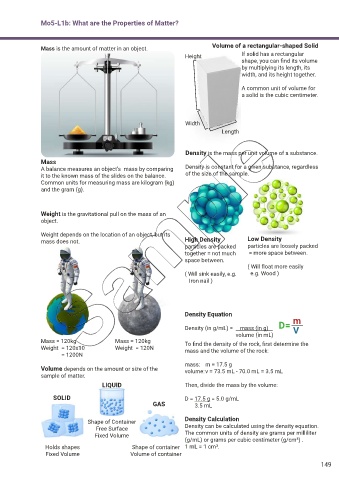
                                                                  Density is the mass per unit volume of a substance.
               Mass
               A balance measures an object’s  mass by comparing   Density is constant for a given substance, regardless
               it to the known mass of the slides on the balance.   of the size of the sample.
               Common units for measuring mass are kilogram (kg)
               and the gram (g).


               Weight is the gravitational pull on the mass of an
               object.
               Weight depends on the location of an object, but its
               mass does not.                                     High Density          Low Density
                                                                  particles are packed   particles are loosely packed
                                                                  together = not much    = more space between.
                                                                  space between.
                                                                                        ( Will float more easily
                                                                  ( Will sink easily, e.g.    e.g. Wood )
                                                                     Iron nail )


                                                                  Density Equation
                                                                                                   D=   m
                                                                  Density (in g/mL) =     mass (in g)     V
                                                                                       volume (in mL)
               Mass = 120kg              Mass = 120kg             To find the density of the rock, first determine the
               Weight  = 120x10          Weight  = 120N           mass and the volume of the rock:
                             = 1200N
                                                                  mass:   m = 17.5 g
               Volume depends on the amount or size of the        volume: v = 73.5 mL - 70.0 mL = 3.5 mL
               sample of matter.
                                     LIQUID                       Then, divide the mass by the volume:

                    SOLID                                         D = 17.5 g = 5.0 g/mL
                                                       GAS               3.5 mL


                                Shape of Container                Density Calculation
                                   Free Surface                   Density can be calculated using the density equation.
                                  Fixed Volume                    The common units of density are grams per milliliter
                                                                  (g/mL) or grams per cubic centimeter (g/cm³) .
                 Holds shapes                  Shape of container 1 mL = 1 cm³.
                 Fixed Volume                  Volume of container
                                                                                                                  149

