


Page 131 - Science Course 1 (Book 2)
P. 131
Mo9-L5a: What are Air Currents?  Mo9-L5a: What are Air Currents?


                                                       Key Concept

                                                      What are Air Currents?

                                          How does uneven heating of Earth’s surface result
                                                        in air movement?


               Global Wind Belts

                                                                                 Polar easterlies
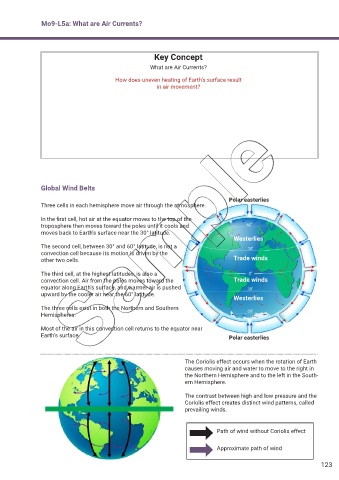
               Three cells in each hemisphere move air through the atmosphere.

               In the f rst cell, hot air at the equator moves to the top of the
               troposphere then moves toward the poles until it cools and
               moves back to Earth’s surface near the 30° latitude.
                                                                                   Westerlies
               The second cell, between 30° and 60° latitude, is not a
               convection cell because its motion is driven by the
               other two cells.                                                    Trade winds

               The third cell, at the highest latitudes, is also a
               convection cell. Air from the poles moves toward the                Trade winds
               equator along Earth’s surface, and warmer air is pushed
               upward by the cooler air near the 60° latitude.
                                                                                   Westerlies
               The three cells exist in both the Northern and Southern
               Hemispheres.

               Most of the air in this convection cell returns to the equator near
               Earth’s surface.                                                  Polar easterlies


                                                                  The Coriolis effect occurs when the rotation of Earth
                                                                  causes moving air and water to move to the right in
                                                                  the Northern Hemisphere and to the left in the South-
                                                                  ern Hemisphere.

                                                                  The contrast between high and low pressure and the
                                                                  Coriolis effect creates distinct wind patterns, called
                                                                  prevailing winds.


                                                                             Path of wind without Coriolis effect


                                                                             Approximate path of wind

                                                                                                                  123

