


Page 114 - Science Course 3 (Book 1)
P. 114
Mo3-L2a: What is Darwin’s Theory of Evolution?


        Charles Darwin                                      Natural selection is the process by which
                                                            populations of organisms with variations that help
        Darwin found that each island in the Galápagos had a   them survive in their environments live longer,
        different environment, and tortoises looked different  compete better, and reproduce more than those
        depending on which island environment they inhabited.   that do not have the variations.

                                                            Natural selection explains how populations change
                                                            as their environments change.


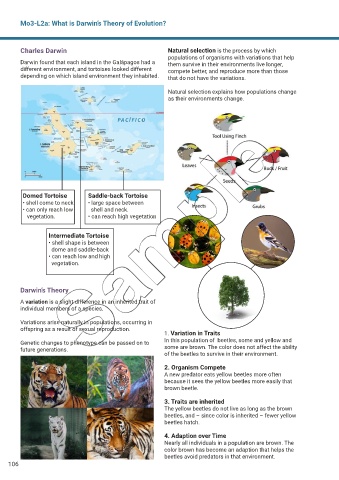
         Domed Tortoise         Saddle-back Tortoise
         • shell come to neck   • large space between
         • can only reach low     shell and neck.
            vegetation.         • can reach high vegetation


                  Intermediate Tortoise
                  • shell shape is between
                    dome and saddle-back
                  • can reach low and high
                    vegetation.


        Darwin’s Theory

        A variation is a slight difference in an inherited trait of
        individual members of a species.

        Variations arise naturally in populations, occurring in
        offspring as a result of sexual reproduction.
                                                           1. Variation in Traits
        Genetic changes to phenotype can be passed on to   In this population of  beetles, some and yellow and
        future generations.                                some are brown. The color does not affect the ability
                                                           of the beetles to survive in their environment.

                                                           2. Organism Compete
                                                           A new predator eats yellow beetles more often
                                                           because it sees the yellow beetles more easily that
                                                           brown beetle.

                                                           3. Traits are inherited
                                                           The yellow beetles do not live as long as the brown
                                                           beetles, and – since color is inherited – fewer yellow
                                                           beetles hatch.

                                                           4. Adaption over Time
                                                           Nearly all individuals in a population are brown. The
                                                           color brown has become an adaption that helps the
                                                           beetles avoid predators in that environment.
    106

