


Page 119 - Science Course 3 (Book 1)
P. 119
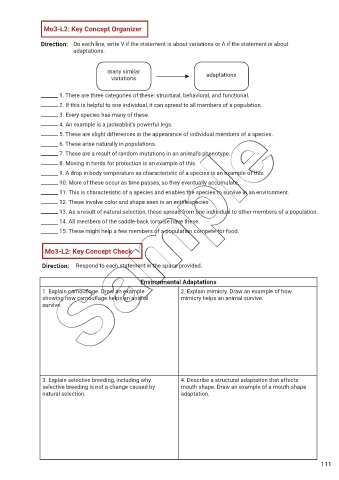
Mo3-L2: Key Concept Organizer


               Direction: On each line, write V if the statement is about variations or A if the statement is about
                           adaptations.


                                       many similar                      adaptations
                                        variations


                      1. There are three categories of these: structural, behavioral, and functional.
                      2. If this is helpful to one individual, it can spread to all members of a population.
                      3. Every species has many of these.
                      4. An example is a jackrabbit’s powerful legs.
                      5. These are slight differences in the appearance of individual members of a species.

                      6. These arise naturally in populations.
                      7. These are a result of random mutations in an animal’s phenotype.
                      8. Moving in herds for protection is an example of this.
                      9. A drop in body temperature as characteristic of a species is an example of this.
                      10. More of these occur as time passes, so they eventually accumulate.
                      11. This is characteristic of a species and enables the species to survive in an environment.
                      12. These involve color and shape seen in an entire species.

                      13. As a result of natural selection, these spread from one individual to other members of a population.
                      14. All members of the saddle-back tortoise have these.
                      15. These might help a few members of a population compete for food.


                 Mo3-L2: Key Concept Check

                Direction:  Respond to each statement in the space provided.


                                                  Environmental Adaptations
                1. Explain camouflage. Draw an example           2. Explain mimicry. Draw an example of how
                showing how camouflage helps an animal           mimicry helps an animal survive.
                survive.


                3. Explain selective breeding, including why     4. Describe a structural adaptation that affects
                selective breeding is not a change caused by     mouth shape. Draw an example of a mouth-shape
                natural selection.                               adaptation.


                                                                                                                  111

