


Page 88 - Science Course 3 (Book 1)
P. 88
Mo2-L6a:How Living Organisms Interact?


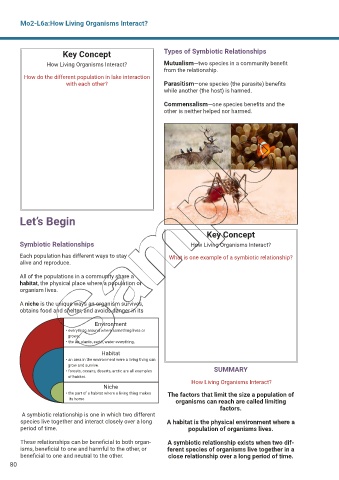
                       Key Concept                         Types of Symbiotic Relationships

                 How Living Organisms Interact?            Mutualism—two species in a community benefit
                                                           from the relationship.
         How do the different population in lake interaction
                        with each other?                   Parasitism—one species (the parasite) benefits
                                                           while another (the host) is harmed.

                                                           Commensalism—one species benefits and the
                                                           other is neither helped nor harmed.


        Let’s Begin

                                                                          Key Concept
        Symbiotic Relationships                                     How Living Organisms Interact?

        Each population has different ways to stay          What is one example of a symbiotic relationship?
        alive and reproduce.

        All of the populations in a community share a
        habitat, the physical place where a population or
        organism lives.

        A niche is the unique ways an organism survives,
        obtains food and shelter, and avoids danger in its

                                  Environment
                        • everything around where something lives or
                          grows.
                        • the air, plants, earth, water everything.
                                     Habitat
                        • an area in the environment were a living thing can
                          grow and survive.
                        • forests, oceans, deserts, arctic are all examples   SUMMARY
                          of habitat.
                                                                     How Living Organisms Interact?
                                     Niche
                        • the part of a habitat where a living thing makes   The factors that limit the size a population of
                           its home                            organisms can reach are called limiting
                                                                              factors.
         A symbiotic relationship is one in which two different
        species live together and interact closely over a long   A habitat is the physical environment where a
        period of time.                                            population of organisms lives.

        These relationships can be beneficial to both organ-  A symbiotic relationship exists when two dif-
        isms, beneficial to one and harmful to the other, or   ferent species of organisms live together in a
        beneficial to one and neutral to the other.         close relationship over a long period of time.
     80

