


Page 141 - Science Course 3 (Book 2)
P. 141
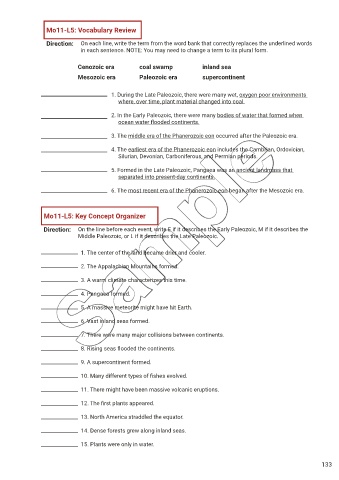
Mo11-L5: Vocabulary Review

                 Direction:  On each line, write the term from the word bank that correctly replaces the underlined words
                             in each sentence. NOTE: You may need to change a term to its plural form.


                            Cenozoic era          coal swamp             inland sea
                            Mesozoic era          Paleozoic era          supercontinent


                                         1. During the Late Paleozoic, there were many wet, oxygen poor environments
                                              where, over time, plant material changed into coal.
                                         2. In the Early Paleozoic, there were many bodies of water that formed when
                                              ocean water f ooded continents.

                                         3. The middle era of the Phanerozoic eon occurred after the Paleozoic era.

                                         4. The earliest era of the Phanerozoic eon includes the Cambrian, Ordovician,
                                              Silurian, Devonian, Carboniferous, and Permian periods.
                                         5. Formed in the Late Paleozoic, Pangaea was an ancient landmass that
                                              separated into present-day continents.

                                         6. The most recent era of the Phanerozoic eon began after the Mesozoic era.


                Mo11-L5: Key Concept Organizer


                Direction:  On the line before each event, write E if it describes the Early Paleozoic, M if it describes the
                            Middle Paleozoic, or L if it describes the Late Paleozoic.


                              1. The center of the land became drier and cooler.

                              2. The Appalachian Mountains formed.

                              3. A warm climate characterizes this time.

                              4. Pangaea formed.

                              5. A massive meteorite might have hit Earth.

                              6. Vast inland seas formed.

                              7. There were many major collisions between continents.

                              8. Rising seas f ooded the continents.

                              9. A supercontinent formed.

                              10. Many different types of f shes evolved.

                              11. There might have been massive volcanic eruptions.

                              12. The f rst plants appeared.

                              13. North America straddled the equator.

                              14. Dense forests grew along inland seas.

                              15. Plants were only in water.


                                                                                                                  133

