


Page 163 - Science Course 3 (Book 2)
P. 163
Mo12-L1b: How Does the Moon Affect Earth?


                                                                  eclipse
                Mo12–L1b      How Does the Moon Affect Earth?
                                                                  the movement of one solar system object into the
                                                                  shadow of another.
               KEY CONCEPTS:
               1. How does the Moon affect Earth?
               2. How do solar and lunar eclipses differ?


                            Vocabulary A-Z

                            Let us learn some vocabulary


                                                                  Let’s Begin


                                                                  Earth’s Moon

                                                                  Gravity holds the Moon
                                                                  in orbit around Earth.

                                                                  The Moon is about
                                                                  one-fourth the size of
                                                                  Earth, is dry, airless,
                                                                  and made mostly of
                                                                  rock.


                                                                  The Moon rotates on its axis, and revolves around
                                                                  Earth, orbiting Earth once every 27.3 days.
                waxing                                            Because the Moon revolves and rotates in the same
                a phase of the moon during which more of the lit   amount of time, the same side of the Moon always
                part of the moon is visible each night.           faces Earth.


                waning
                a phase of the moon during which less of the lit
                part of the moon is visible each night.


                tide
                the periodic rise and fall of the ocean’s surface
                caused by the gravitational force between earth
                and the moon, and earth and the sun.

                                 Low tide


                                                High tide

                  High tide
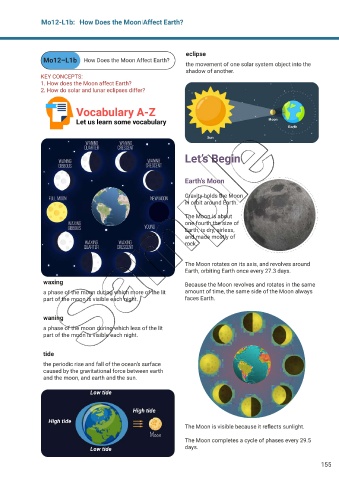
                                                                  The Moon is visible because it ref ects sunlight.

                                                                  The Moon completes a cycle of phases every 29.5
                                 Low tide                         days.

                                                                                                                  155

