


Page 166 - Science Course 3 (Book 2)
P. 166
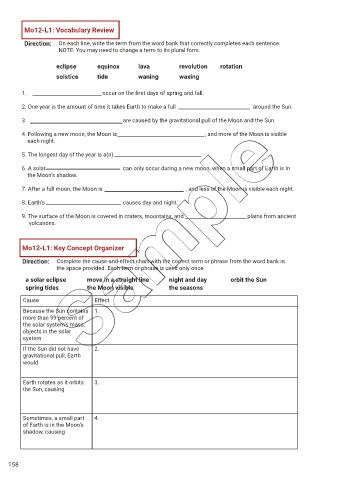
Mo12-L1: Vocabulary Review

          Direction:  On each line, write the term from the word bank that correctly completes each sentence.
                      NOTE: You may need to change a term to its plural form.


                     eclipse       equinox        lava          revolution    rotation
                     solstice      tide           waning        waxing


         1.                          occur on the f rst days of spring and fall.

         2. One year is the amount of time it takes Earth to make a full                    around the Sun.

         3.                                 are caused by the gravitational pull of the Moon and the Sun.

         4. Following a new moon, the Moon is                            , and more of the Moon is visible
             each night.

         5. The longest day of the year is a(n)                           .

         6. A solar                         can only occur during a new moon, when a small part of Earth is in
             the Moon’s shadow.

         7. After a full moon, the Moon is                         , and less of the Moon is visible each night.

         8. Earth’s                         causes day and night.

         9. The surface of the Moon is covered in craters, mountains, and               plains from ancient
              volcanoes.


         Mo12-L1: Key Concept Organizer
         Direction:  Complete the cause-and-effect chart with the correct term or phrase from the word bank in
                     the space provided. Each term or phrase is used only once.
          a solar eclipse       move in a straight line     night and day         orbit the Sun
          spring tides          the Moon visible            the seasons

         Cause                    Effect
         Because the Sun contains  1.
         more than 99 percent of
         the solar system’s mass,
         objects in the solar
         system

         If the Sun did not have   2.
         gravitational pull, Earth
         would


         Earth rotates as it orbits   3.
         the Sun, causing


         Sometimes, a small part   4.
         of Earth is in the Moon’s
         shadow, causing


    158

