


Page 108 - Math Course 2 (Book 2)
P. 108
Transformations: Using Vectors


        Solve Problems Using Vectors

            Example
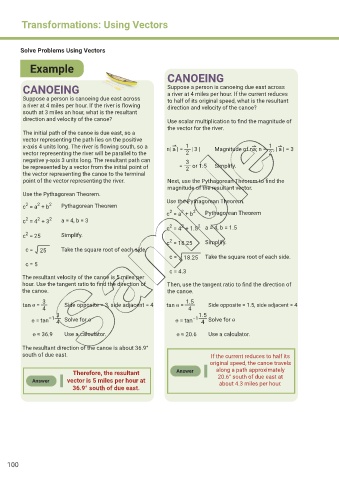
                                                            CANOEING

         CANOEING                                           Suppose a person is canoeing due east across

         Suppose a person is canoeing due east across       a river at 4 miles per hour. If the current reduces
                                                            to half of its original speed, what is the resultant
         a river at 4 miles per hour. If the river is flowing   direction and velocity of the canoe?
         south at 3 miles an hour, what is the resultant
         direction and velocity of the canoe?               Use scalar multiplication to find the magnitude of
                                                            the vector for the river.
         The initial path of the canoe is due east, so a
         vector representing the path lies on the positive
                                                                  1
                                                                                               1
         x-axis 4 units long. The river is flowing south, so a   n| a | =      | 3 |  Magnitude of na; n =     , | a | = 3
         vector representing the river will be parallel to the    2                            2
         negative y-axis 3 units long. The resultant path can     3
         be represented by a vector from the initial point of            =       or 1.5  Simplify.
                                                                  2
         the vector representing the canoe to the terminal
         point of the vector representing the river.        Next, use the Pythagorean Theorem to find the
                                                            magnitude of the resultant vector.
         Use the Pythagorean Theorem.
                                                            Use the Pythagorean Theorem.
          2
              2
         c  = a  + b 2  Pythagorean Theorem
                                                             2
                                                                 2
                                                            c  = a  + b 2  Pythagorean Theorem
              2
          2
         c  = 4  + 3 2  a = 4, b = 3
                                                                 2
                                                             2
                                                            c  = 4  + 1.5 2  a = 4, b = 1.5
          2
         c  = 25       Simplify.
                                                             2
                                                            c  = 18.25   Simplify.
           c =  25     Take the square root of each side.
                                                              c =  18.25  Take the square root of each side.
           c = 5
                                                              c = 4.3
         The resultant velocity of the canoe is 5 miles per
         hour. Use the tangent ratio to find the direction of   Then, use the tangent ratio to find the direction of
         the canoe.                                         the canoe.
                3                                                 1.5
         tan � =        Side opposite = 3, side adjacent = 4  tan � =     Side opposite = 1.5, side adjacent = 4
                4                                                  4
                     3                                                 1.5
                � = tan –1  4  Solve for �                         � = tan –1  4  Solve for �
                � ≈ 36.9  Use a calculator.                        � ≈ 20.6  Use a calculator.

         The resultant direction of the canoe is about 36.9°
         south of due east.                                                If the current reduces to half its
                                                                           original speed, the canoe travels
                           Therefore, the resultant            Answer        along a path approximately
            Answer       vector is 5 miles per hour at                        20.6° south of due east at
                                                                              about 4.3 miles per hour.
                           36.9° south of due east.


    100

