


Page 82 - Math Course 2 (Book 2)
P. 82
Transformations: Translated Images


                                                           Find a Translation Using Reflections
         To find the translation from raindrop 2 to raindrop
         3, use the coordinates at the top of each raindrop.
         Use the coordinates (1, 2) and (–1, –1) in the       Example
         formula.
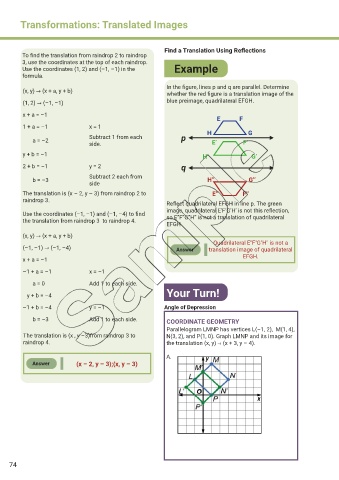
                                                            In the figure, lines p and q are parallel. Determine
         (x, y) → (x + a, y + b)                            whether the red figure is a translation image of the

         (1, 2) → (–1, –1)                                  blue preimage, quadrilateral EFGH.
         x + a = –1
                                                                             E       F
         1 + a = –1             x = 1
                                Subtract 1 from each             p        H             G
                a = –2                                                     E’         F’
                                side.
         y + b = –1                                                     H’               G’

         2 + b = –1             y = 2                            q
                                Subtract 2 each from
                b = –3                                                    H’’           G’’
                                side
         The translation is (x – 2, y – 3) from raindrop 2 to               E’’       F’’
         raindrop 3.
                                                           Reflect quadrilateral EFGH in line p. The green
                                                           image, quadrilateral E’F’G’H’ is not this reflection,
         Use the coordinates (–1, –1) and (–1, –4) to find   so E’’F’’G’’H’‘ is not a translation of quadrilateral
         the translation from raindrop 3  to raindrop 4.
                                                           EFGH
         (x, y) → (x + a, y + b)
                                                                            Quadrilateral E''F''G''H'' is not a
         (–1, –1) → (–1, –4)                                   Answer     translation image of quadrilateral
                                                                                      EFGH.
         x + a = –1

         –1 + a = –1            x = –1
                a = 0           Add 1 to each side.

            y + b = –4                                      Your Turn!
         –1 + b = –4            y = –1                     Angle of Depression

                b = –3          Add 1 to each side.         COORDINATE GEOMETRY
                                                            Parallelogram LMNP has vertices L(–1, 2),  M(1, 4),
         The translation is (x , y –3)from raindrop 3 to     N(3, 2), and P(1, 0). Graph LMNP and its image for
         raindrop 4.                                        the translation (x, y)   (x + 3, y – 4).

                                                            A.
            Answer          (x – 2, y – 3);(x, y – 3)


    74

