


Page 133 - Science Course 1 (Book 1)
P. 133
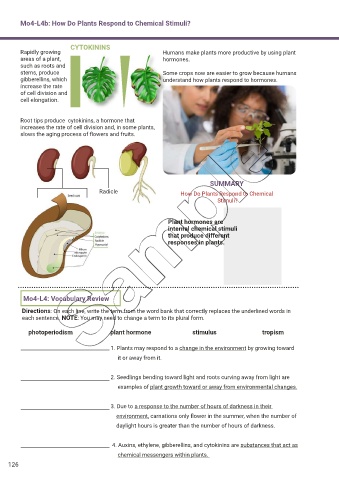
Mo4-L4b: How Do Plants Respond to Chemical Stimuli?


                          CYTOKININS
        Rapidly growing                                   Humans make plants more productive by using plant
        areas of a plant,                                 hormones.
        such as roots and
        stems, produce                                    Some crops now are easier to grow because humans
        gibberellins, which                               understand how plants respond to hormones.
        increase the rate
        of cell division and
        cell elongation.


        Root tips produce  cytokinins, a hormone that
        increases the rate of cell division and, in some plants,
        slows the aging process of flowers and fruits.


                                                                           SUMMARY
                                    Radicle                     How Do Plants Respond to Chemical
                                                                              Stimuli?


                                                            Plant hormones are
                                                            internal chemical stimuli
                                                            that produce different
                                                            responses in plants.


          Mo4-L4: Vocabulary Review

         Directions: On each line, write the term from the word bank that correctly replaces the underlined words in
         each sentence. NOTE: You may need to change a term to its plural form.

           photoperiodism               plant hormone                stimulus                tropism

                                        1. Plants may respond to a change in the environment by growing toward

                                             it or away from it.


                                        2. Seedlings bending toward light and roots curving away from light are
                                             examples of plant growth toward or away from environmental changes.


                                        3. Due to a response to the number of hours of darkness in their
                                            environment, carnations only flower in the summer, when the number of
                                            daylight hours is greater than the number of hours of darkness.


                                         4. Auxins, ethylene, gibberellins, and cytokinins are substances that act as
                                             chemical messengers within plants.
    126

