


Page 42 - Science Course 2 (Book 1)
P. 42
Mo2-L2b:  What Can Help Maintain Homeostasis?


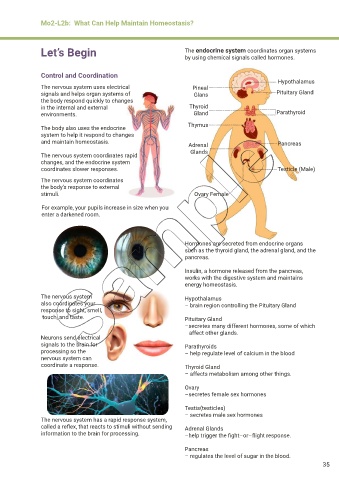
               Let’s Begin                                        The endocrine system coordinates organ systems
                                                                  by using chemical signals called hormones.


               Control and Coordination
                                                                                                   Hypothalamus
               The nervous system uses electrical                    Pineal
               signals and helps organ systems of                     Glans                       Pituitary Gland
               the body respond quickly to changes
               in the internal and external                         Thyroid
               environments.                                         Gland                        Parathyroid

               The body also uses the endocrine                    Thymus
               system to help it respond to changes
               and maintain homeostasis.                                                           Pancreas
                                                                   Adrenal
                                                                    Glands
               The nervous system coordinates rapid
               changes, and the endocrine system
               coordinates slower responses.                                                       Testicle (Male)

               The nervous system coordinates
               the body’s response to external
               stimuli.                                              Ovary Female

                For example, your pupils increase in size when you
                enter a darkened room.


                                                                  Hormones are secreted from endocrine organs
                                                                  such as the thyroid gland, the adrenal gland, and the
                                                                  pancreas.
                                                                  Insulin, a hormone released from the pancreas,
                                                                  works with the digestive system and maintains
                                                                  energy homeostasis.
               The nervous system                                 Hypothalamus
               also coordinates your                              – brain region controlling the Pituitary Gland
               response to sight, smell,
                touch, and taste.                                 Pituitary Gland
                                                                  –secretes many different hormones, some of which
                                                                     affect other glands.
               Neurons send electrical
               signals to the brain for                           Parathyroids
               processing so the                                  – help regulate level of calcium in the blood
               nervous system can
               coordinate a response.                             Thyroid Gland
                                                                  – affects metabolism among other things.

                                                                  Ovary
                                                                  –secretes female sex hormones
                                                                  Testis(testicles)
                                                                  – secretes male sex hormones
               The nervous system has a rapid response system,
               called a reflex, that reacts to stimuli without sending   Adrenal Glands
               information to the brain for processing.           –help trigger the fight–or–flight response.


                                                                  Pancreas
                                                                  – regulates the level of sugar in the blood.
                                                                                                                  35

