


Page 92 - Math Course 2 (Book 2)
P. 92
Transformations: Regular Tessellations


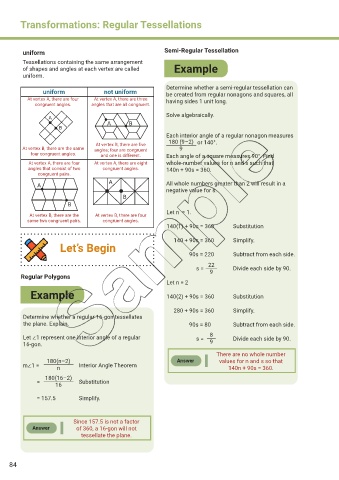
         uniform                                           Semi-Regular Tessellation
         Tessellations containing the same arrangement
         of shapes and angles at each vertex are called       Example
         uniform.
                                                           Determine whether a semi-regular tessellation can
                uniform               not uniform          be created from regular nonagons and squares, all
           At vertex A, there are four   At vertex A, there are three   having sides 1 unit long.
             congruent angles.   angles that are all congruent.

                  A                                        Solve algebraically.
                                       A      B
                      B
                                                           Each interior angle of a regular nonagon measures
                                                            180 (9–2)
                                   At vertex B, there are five                         or 140°.
         At vertex B, there are the same   angles; four are congruent   9
            four congruent angles.  and one is different.  Each angle of a square measures 90°. Find
           At vertex A, there are four   At vertex A, there are eight    whole-number values for n and s such that
           angles that consist of two   congruent angles.  140n + 90s = 360.
              congruent pairs.
                                       A                   All whole numbers greater than 2 will result in a
              A
                                                           negative value for s.
                                            B
                         B
                                                            Let n  = 1.
           At vertex B, there are the   At vertex B, there are four
           same two congruent pairs.  congruent angles.
                                                            140(1) + 90s = 360     Substitution

                                                                 140 + 90s = 360   Simplify.
                      Let’s Begin
                                                                            90s = 220  Subtract from each side.
                                                                          22
                                                                                 s =   9  Divide each side by 90.
        Regular Polygons
                                                            Let n = 2
            Example                                         140(2) + 90s = 360     Substitution


                                                                 280 + 90s = 360   Simplify.
         Determine whether a regular 16-gon tessellates
         the plane. Explain.                                                90s = 80  Subtract from each side.

         Let ∠1 represent one interior angle of a regular                         s =  8  Divide each side by 90.
         16-gon.                                                           9
                                                                             There are no whole number
                 180(n–2)                                      Answer         values for n and s so that
         m∠1 =       n       Interior Angle Theorem                              140n + 90s = 360.

                 180(16–2)
                   =  16     Substitution

                   = 157.5   Simplify.


                           Since 157.5 is not a factor
            Answer          of 360, a 16-gon will not
                              tessellate the plane.


    84

