


Page 166 - Science Course 1 (Book 1)
P. 166
Mo5-L2b: How Do Particles Move in Solids, Liquids, and Gases?


                              Key Concept                         Viscosity is a measurement of a liquid’s resistance
                                                                  to flow.
                        How Do Particles Move in Solids,
                              Liquids, and Gases?
                 Describe the movement of particles in a solid and
                            the forces between them.


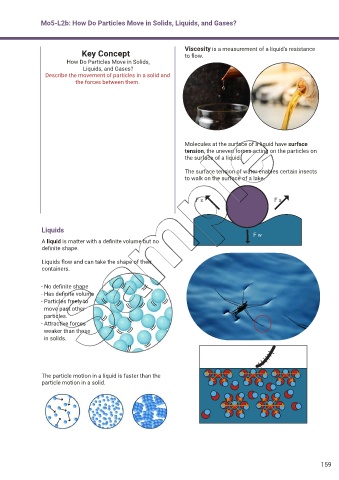
                                                                  Molecules at the surface of a liquid have surface
                                                                  tension, the uneven forces acting on the particles on
                                                                  the surface of a liquid.

                                                                  The surface tension of water enables certain insects
                                                                  to walk on the surface of a lake.


                                                                      F s                        F s


                Liquids
                                                                                          F w
                A liquid is matter with a definite volume but no
                definite shape.
                Liquids flow and can take the shape of their
                containers.


               - No definite shape
               - Has definite volume
               - Particles freely to
                 move past other
                 particles.
               - Attractive forces
                 weaker than those
                 in solids.


                The particle motion in a liquid is faster than the
                particle motion in a solid.


                                                                                                                  159

