


Page 120 - Science Course 2 (Book 1)
P. 120
Mo4-L3b:  What  is the pH of a Solution?


               All acid and base solutions contain both hydronium   The pH scale is used to indicate how acidic or basic
               and hydroxide ions. In a neutral solution, such as   a solution is.
               water, the concentrations of hydronium and
               hydroxide ions are equal.

               Acids have a greater concentration of hydronium
               ions than hydroxide ions.

               Bases have a greater concentration of hydroxide
               ions than hydronium ions.

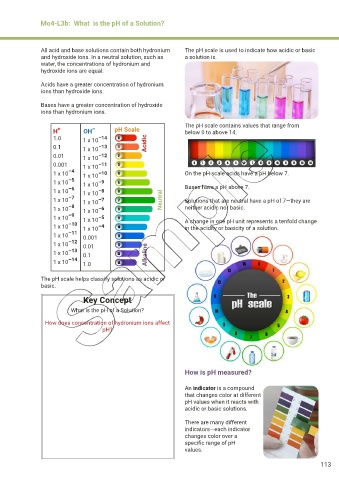
                                                                  The pH scale contains values that range from
                    H +       OH –       pH Scale                 below 0 to above 14.
                    1.0       1 x 10 –14
                    0.1       1 x 10 –13            Acidic
                    0.01      1 x 10 –12
                    0.001     1 x 10 –11
                    1 x 10 –4  1 x 10 –10                         On the pH scale acids have a pH below 7.
                    1 x 10 –5  1 x 10 –9                          Bases have a pH above 7.
                    1 x 10 –6  1 x 10 –8
                    1 x 10 –7  1 x 10 –7                  Neutral  Solutions that are neutral have a pH of 7—they are
                    1 x 10 –8  1 x 10 –6                          neither acidic nor basic.
                    1 x 10 –9  1 x 10 –5                          A change in one pH unit represents a tenfold change
                    1 x 10 –10  1 x 10 –4                         in the acidity or basicity of a solution.
                    1 x 10 –11  0.001
                    1 x 10 –12  0.01
                    1 x 10 –13  0.1                  Alkaline
                    1 x 10 –14  1.0


               The pH scale helps classify solutions as acidic or
               basic.
                              Key Concept

                          What is the pH of a Solution?

                 How does concentration of hydronium ions affect
                                     pH?


                                                                  How is pH measured?


                                                                  An indicator is a compound
                                                                  that changes color at different
                                                                  pH values when it reacts with
                                                                  acidic or basic solutions.

                                                                  There are many different
                                                                  indicators—each indicator
                                                                  changes color over a
                                                                  specific range of pH
                                                                  values.

                                                                                                                  113

