


Page 191 - Science Course 1 (Book 1)
P. 191
Mo6-L1a: How did the Atomic Theory Start?


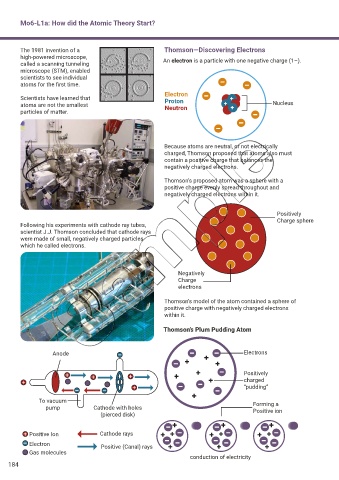
        The 1981 invention of a                            Thomson—Discovering Electrons
        high-powered microscope,                          An electron is a particle with one negative charge (1–).
        called a scanning tunneling
        microscope (STM), enabled
        scientists to see individual
        atoms for the first time.
                                                           Electron
        Scientists have learned that                       Proton                 +
        atoms are not the smallest                         Neutron              +  +             Nucleus
        particles of matter.


                                                           Because atoms are neutral, or not electrically
                                                           charged, Thomson proposed that atoms also must
                                                           contain a positive charge that balances the
                                                           negatively charged electrons.

                                                           Thomson’s proposed atom was a sphere with a
                                                           positive charge evenly spread throughout and
                                                           negatively charged electrons within it.


                                                                                                  Positively
                                                                                                  Charge sphere
        Following his experiments with cathode ray tubes,
        scientist J.J. Thomson concluded that cathode rays
        were made of small, negatively charged particles
        which he called electrons.


                                                                Negatively
                                                                Charge
                                                                electrons

                                                           Thomson’s model of the atom contained a sphere of
                                                           positive charge with negatively charged electrons
                                                           within it.

                                                          Thomson’s Plum Pudding Atom


                   Anode                                                               Electrons


                                                                                       Positively
                                                                                       charged
                                                                                       “pudding”

               To vacuum                                                                  Forming a
                 pump             Cathode with holes                                      Positive ion
                                    (pierced disk)


           Positive Ion             Cathode rays
           Electron                 Positive (Canal) rays
           Gas molecules
                                                                    conduction of electricity
    184

