


Page 217 - Science Course 1 (Book 1)
P. 217
Mo6-L3b: What Happens if There are Changes in an Atom?


                                                                            SUMMARY
                       Key Concept                              What Happens if There are Changes in an
          What Happens if There are Changes in an Atom?                        Atom?
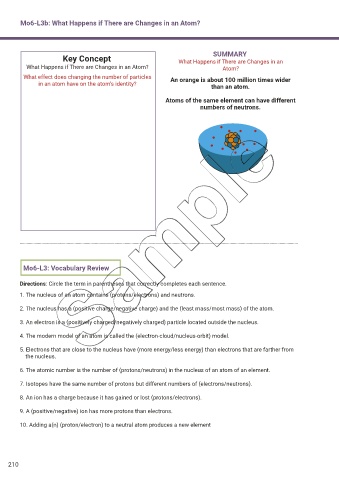
         What effect does changing the number of particles   An orange is about 100 million times wider
               in an atom have on the atom’s identity?                     than an atom.

                                                           Atoms of the same element can have different
                                                                       numbers of neutrons.


          Mo6-L3: Vocabulary Review

        Directions: Circle the term in parentheses that correctly completes each sentence.

        1. The nucleus of an atom contains (protons/electrons) and neutrons.

        2. The nucleus has a (positive charge/negative charge) and the (least mass/most mass) of the atom.

        3. An electron is a (positively charged/negatively charged) particle located outside the nucleus.

        4. The modern model of an atom is called the (electron-cloud/nucleus-orbit) model.

        5. Electrons that are close to the nucleus have (more energy/less energy) than electrons that are farther from
            the nucleus.

        6. The atomic number is the number of (protons/neutrons) in the nucleus of an atom of an element.

        7. Isotopes have the same number of protons but different numbers of (electrons/neutrons).

        8. An ion has a charge because it has gained or lost (protons/electrons).

        9. A (positive/negative) ion has more protons than electrons.

        10. Adding a(n) (proton/electron) to a neutral atom produces a new element


    210

